


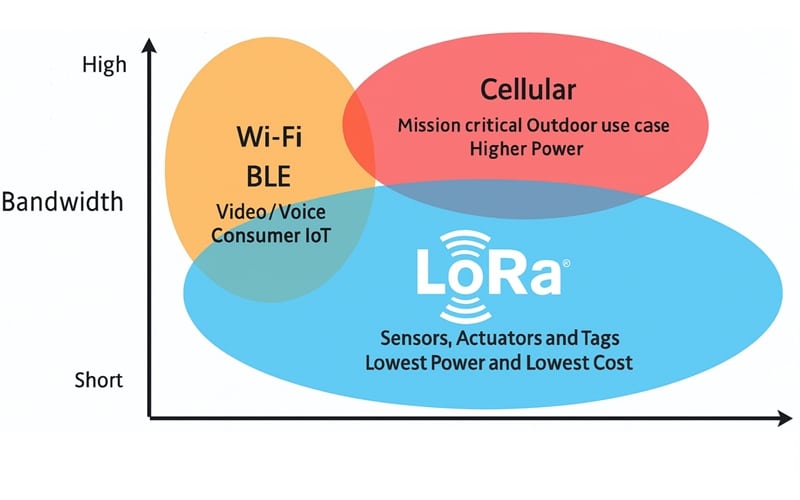

Designing a wireless IoT device for worldwide asset tracking depends on where the device needs to go and what wireless services are available. The future of asset tracking lies not in choosing a single technology, but in intelligently combining them to create systems that are greater than the sum of their parts.
Until recently, building an IoT device, such as one for asset tracking, meant choosing a single networking technology, such as Wi-Fi, Bluetooth, LoRa, or cellular 5G, based on application requirements. The variety of technologies gave designers options, but trade-offs were inevitable. Engineers were forced to compromise among power consumption, range, cost, and coverage, or between battery life and data throughput. That’s no longer the case, which leads to more design decisions.
Figure 1. Asset management examples leverage multi-connectivity to optimize coverage and power consumption.
Demands on tracking have evolved beyond simple location reporting to include comprehensive monitoring of environmental conditions, movement patterns and real-time status updates. Hybrid IoT architectures that combine multiple network technologies — particularly LoRa and cellular connectivity, including 5G low power wide area (LPWA) — are emerging as the preferred solution for global asset tracking systems. These hybrid approaches (Figure 1) address the fundamental limitations that constrain single-technology implementations while opening new possibilities for comprehensive monitoring across diverse operational environments.
Improved power-management techniques let devices intelligently switch between communication modes based on availability and requirements. Meanwhile, advances in cloud-based device management platforms provide the infrastructure necessary to coordinate complex multi-technology deployments at scale.
The Role of LoRa and LoRaWAN

Figure 2. LoRaWAN is an open source LPWAN standard managed by the LoRa Alliance leveraging LoRa.
Long Range (LoRa) is a physical layer (PHY) technology (Figure 2) that represents a low-power wide-area network (LPWAN) solution designed specifically for applications requiring long battery life and extended communication range. Operating in unlicensed Industrial, Scientific and Medical (ISM) sub-gigahertz frequency bands, LoRa employs a spread-spectrum modulation technique that enables communication over distances of several kilometers with superior material penetration while consuming minimal power. The same modulation can also extend to higher frequency bands such as ISM 2.4 GHz, capable of reaching higher data rates and global operation with a single transceiver.
LoRaWAN is an open networking ITU-T Y.4480 standard managed by the LoRa Alliance that leverages LoRa. The Media Access Control (MAC) layer delivers secure bidirectional communication for both fixed and mobile end nodes.
The fundamental characteristics of LoRaWAN make it particularly suitable for asset tracking in controlled environments. Devices can operate for years on a single battery charge, transmitting small data packets containing location coordinates, sensor readings and status information. The technology supports adaptive data rates, letting devices optimize transmission parameters based on link conditions and power requirements.

Figure 3. Typical LoRaWAN network architecture showing end devices connecting wirelessly to gateways and then to LoRaWAN Network Server, LoRaWAN Join Server, and LoRaWAN Application Server.
In asset tracking deployments, LoRaWAN typically operates within a star topology where end devices communicate directly with gateways connected to network servers (Figure 3). This architecture provides strong coverage in industrial facilities, logistics centers, and urban environments where LoRa gateways can be strategically positioned. It can operate in applications such as container tracking within ports, equipment monitoring in manufacturing facilities, and livestock tracking on agricultural properties.
LoRa’s dependence on gateway infrastructure (Figure 4), however, limits its effectiveness in truly global applications. While LoRa can provide reliable communication within its coverage area, gaps in gateway deployment can create blind spots where tracked assets become invisible to monitoring systems. Additionally, LoRa’s low data rates, while sufficient for basic telemetry, may not support applications requiring frequent updates or rich data payloads. That’s where cellular comes in.

Figure 4. LoRa Edge enables integration of complementary technologies for asset tracking.
5G’s role extends beyond basic connectivity to enable advanced applications such as real-time video monitoring, predictive maintenance based on continuous sensor data analysis, and integration with artificial intelligence platforms for automated decision-making. 5G’s low latency (less than 1 ms) supports applications requiring fast response to tracked asset conditions, such as cold-chain monitoring or security-alert systems.
Network connectivity through mobile virtual network operators (MVNOs) provides additional flexibility for global deployments. MVNOs can offer specialized data plans optimized for IoT applications, simplified device-management interfaces, and consolidated billing across multiple countries. This approach reduces the complexity of managing relationships with multiple network operators while providing the global coverage needed for comprehensive asset tracking.
Role of 5G and cellular technologies
Cellular ecosystems represent the evolution of wide-area wireless communication, offering enhanced data rates, reduced latency, and improved connectivity for IoT applications. Cellular networks provide extensive global coverage to monitor assets across diverse locations, leveraging the infrastructure investments made by network operators worldwide. While 5G deployment is expanding rapidly, current coverage remains concentrated in urban and suburban areas, with 4G/LTE networks continuing to provide the backbone for global connectivity.
The cellular ecosystem encompasses deployment options relevant to asset tracking applications. Narrowband IoT (NB-IoT), a cellular technology designed specifically for IoT applications, operates within existing LTE frequency bands while providing extended coverage and improved power efficiency compared to traditional cellular technologies. NB-IoT supports battery-powered devices that can operate for up to 10 years, making it suitable for long-term deployments.
The transition from legacy cellular technologies to 5G makes deployment decisions more complex. While 3G networks face sunset dates in many regions, creating urgency for migration to newer technologies, 2G networks remain operational in many areas and continue to support existing deployments. This transition period requires careful planning to ensure continuity of service while optimizing for future network evolution.
Cost and Regulatory Considerations
Deployment costs vary significantly depending on the technology. LoRa networks require upfront gateway infrastructure expenses but offer low ongoing operational costs. Cellular connectivity involves subscription fees that scale with the number of devices and data usage, but eliminates infrastructure deployment requirements. Regulatory considerations also differ by region, with LoRa operating in unlicensed spectrum subject to duty cycle restrictions, while cellular networks operate under licensed spectrum with guaranteed quality of service.
LoRa Edge represents an advanced integration approach that combines LoRa connectivity with complementary positioning and sensing technologies. This integrated solution demonstrates how hybrid systems can seamlessly incorporate multiple technologies within unified device architectures.
Effective hybrid asset-tracking systems integrate additional technologies beyond LoRa and cellular to achieve comprehensive coverage and location-awareness across diverse operational environments. The Global Navigation Satellite System (GNSS) provides the fundamental positioning capability that enables accurate location determination. Modern GNSS receivers support multiple constellation systems, including GPS, GLONASS, Galileo, and BeiDou, improving accuracy and availability in challenging environments. LoRa can serve as a long-range link to transmit differential GNSS or RTK information between the base station and the rover to reach centimeter-level accuracy.
Passive Wi-Fi access-point scanning offers an alternative positioning method, particularly valuable for indoor environments where GNSS signals may be unavailable or unreliable. By detecting and analyzing Wi-Fi beacon signals from nearby access points, devices can determine their approximate location using database correlation techniques. This approach requires no active connection to Wi-Fi networks, preserving power while providing valuable location information in buildings, warehouses and other enclosed spaces.
Bluetooth Low Energy (BLE) beaconing enables precise positioning within localized areas through fixed-beacon infrastructure. BLE beacons can provide room-level accuracy in indoor environments, supporting applications such as equipment tracking within facilities or personnel monitoring in hazardous areas. Bluetooth’s low power consumption allows for extended deployment periods with minimal maintenance requirements.
Round-trip time of flight (RTToF) ranging technology adds another dimension to location determination by measuring the time required for radio signals to travel between devices. This technique can provide distance measurements with sub-meter accuracy between devices, enabling applications such as proximity detection, geofencing, and relative positioning between tracked assets. RTToF implementations often leverage existing radio technologies, adding ranging capability without requiring additional hardware components.
Hybrid system design considerations
The architecture of hybrid LoRa-cellular asset-tracking systems requires careful consideration of multiple factors, including power management, antenna design, and protocol coordination. Successful implementations typically employ intelligent switching algorithms that select the most appropriate communication technology based on current conditions, power status, and application requirements.
Modern hybrid systems implement sophisticated decision engines that evaluate multiple criteria when selecting communication paths:
- Network availability and signal strength: Systems continuously monitor available networks and signal quality.
- Power consumption optimization: Algorithms consider the remaining battery life and the power requirements of each technology.
- Data priority and latency requirements: Critical alerts may trigger immediate cellular transmission while routine telemetry uses LoRa.
- Cost optimization: Systems can prioritize lower-cost LoRa transmission when cellular data costs are a concern.
- Location-based decisions: GPS coordinates can trigger technology selection based on known coverage maps.

Figure 5. A multi-radio module might include support for LoRa, Cellular, Wi-Fi, Bluetooth, or any combination. Image: SG Wireless
The convergence of wireless technologies has made hybrid systems practical. Module miniaturization enables the integration of multiple radio technologies within compact form factors.
Device-level design considerations include integrating multiple RF sections within compact form factors. Combo modules, such as the one shown in Figure 5, can incorporate LoRa, cellular, GNSS, and short-range radio capabilities, reducing size and power consumption while simplifying board-level design. Antenna design, however, becomes critical as multiple radio technologies operating across different frequency bands require careful consideration of radiation patterns, isolation, and efficiency.
Network configuration and data synchronization
Network configuration in hybrid systems involves coordinating among communication paths to ensure seamless operation. Cloud-based device management platforms typically serve as the central coordination point, receiving data from devices through multiple network paths and presenting unified interfaces to end-user applications. These platforms must manage protocol translation, data fusion from multiple sources, and intelligent routing decisions based on cost, latency, and reliability requirements.
Data synchronization presents unique challenges when information arrives through different paths with varying latencies. Systems must implement timestamp correlation, duplicate detection, and data ordering mechanisms to maintain coherent asset status information.
The system must also address device provisioning and management across multiple network technologies. This includes managing cellular network credentials, LoRa network keys, and application-specific configuration parameters. Over-the-air update capabilities become essential for maintaining large deployments, particularly when devices operate in remote locations where physical access is impractical.
Technical challenges and solutions
Implementing hybrid LoRa-cellular systems presents technical challenges that require careful engineering design. Understanding these challenges and their proven solutions is crucial for successful deployment.
Latency management becomes complex when data paths involve multiple network technologies with distinct characteristics. While LoRa networks may introduce delays measured in seconds, cellular networks can provide sub-second response times. Applications must account for these variations and implement appropriate buffering and synchronization mechanisms.
Solutions Include:
- Implementing adaptive timeout mechanisms that adjust based on the selected communication path.
- Using timestamp-based data ordering at the application level.
- Deploying edge computing capabilities to reduce latency for time-critical decisions.
- Creating priority queues that route urgent data through faster networks.
Seamless technology handoff
Handoff between different communication technologies requires sophisticated decision algorithms that consider factors such as network availability, signal quality, power consumption, and cost. Seamless transitions between LoRa and cellular networks must occur without data loss or application disruption.
- Maintaining parallel communication paths during transition periods.
- Implementing robust error recovery and data retransmission mechanisms.
- Using predictive algorithms that anticipate network changes based on location and historical data.
- Deploying local data buffering to ensure no information is lost during transitions.
Battery life
Battery life optimization in multi-radio devices requires dynamic power management that considers the power consumption characteristics of each technology. While LoRa transmissions consume minimal power, cellular connections can drain batteries rapidly if not managed carefully. Some power management solutions include:
- Implementing intelligent duty cycling that coordinates sleep modes across all radios.
- Using location-based power profiles that adjust behavior in known coverage areas.
- Deploying adaptive transmission scheduling based on data priority and battery status.
- Utilizing energy harvesting technologies where applicable to extend operational life.
RF interference and coexistence
Interference among multiple radio technologies operating within the same device requires careful RF design and filtering. Antenna placement, shielding, and filtering must prevent desensitization while maintaining acceptable performance across all supported frequency bands. RF design best practices include:
- Implementing proper antenna isolation through spatial separation and filtering.
- Using time-division multiplexing to avoid simultaneous transmission conflicts.
- Deploying adaptive frequency selection to avoid interference.
- Incorporating software-defined radio techniques for dynamic spectrum management.
Performance comparison
Security implementation becomes significantly more complex in hybrid systems due to the multiple communication paths and protocols involved. Each technology in Table 1 requires appropriate encryption, authentication, and key management procedures, while maintaining end-to-end security regardless of the communication path in use. A comprehensive security framework must address:
- End-to-end encryption remains intact regardless of the communication path.
- Identity management across different network technologies and operators.
- Key management systems that can handle LoRaWAN application keys, cellular SIM credentials, and application-layer certificates.
- Certificate management for cellular connectivity and cloud platform authentication.
- Secure firmware updates that can be delivered through any available communication path.

Table 1. IoT wireless technology comparison.
Managing cryptographic keys across multiple technologies presents unique challenges:
- LoRaWAN networks require application session keys and network session keys.
- Cellular networks use SIM-based authentication with operator-specific credentials.
- Cloud platforms require application-layer authentication tokens and certificates.
- Over-the-air updates require secure bootstrapping and verification mechanisms.
Best practices for hybrid security include:
- Implement hardware security modules (HSMs) or secure elements for key storage.
- Use mutual authentication between devices and cloud platforms.
- Deploy regular key rotation schedules appropriate for each technology.
- Maintain audit trails that track which communication path transmitted each piece of data.
- Implement intrusion detection systems that monitor for anomalous behavior across all network paths.
Best practices and evaluation criteria
Successful deployment of hybrid LoRa-cellular asset tracking systems requires adherence to best practices developed through field experience and careful evaluation of specific use-case requirements. Device selection should prioritize solutions that integrate multiple radio technologies with proven interoperability and robust power-management capabilities. Field testing across the intended deployment environment is essential to validate coverage, performance, and battery life under real-world conditions.
Comprehensive field testing should include:
- Coverage mapping for both LoRa gateways and cellular networks across the deployment area.
- Power consumption measurement under various operating scenarios.
- Data transmission reliability testing under different environmental conditions.
- Handoff performance evaluation in areas with overlapping coverage.
Network planning and coverage analysis
Network planning must account for the numerous coverage characteristics of each technology, identifying areas where LoRa gateways provide optimal coverage and regions where cellular connectivity is the primary communication path. This analysis should consider factors such as building penetration, terrain effects, and network operator coverage maps. Below are some use-case-specific recommendations.
For urban locations:
- Leverage LoRa for cost-effective routine monitoring.
- Use cellular for real-time alerts and high-priority communications.
- Implement Wi-Fi positioning for indoor location accuracy.
- Deploy BLE beacons for room-level tracking in facilities.
For rural and remote monitoring:
- Prioritize cellular coverage with satellite backup options.
- Use LoRa for local area networking around central facilities.
- Implement edge computing to reduce dependency on constant connectivity.
- Deploy solar charging systems for extended battery life.
For supply chain and logistics:
- Implement handoff algorithms optimized for mobility.-
- Use geofencing to trigger appropriate technology selection.
- Deploy predictive maintenance based on movement patterns.
- Integrate with existing logistics-management systems.
For industrial equipment monitoring:
- Use LoRa for dense sensor networks within facilities.
- Implement cellular backup for critical equipment alerts.
- Deploy edge analytics for immediate fault detection.
- Integrate with enterprise maintenance management systems.
Evaluation criteria for organizations
Organizations considering hybrid LoRa-cellular systems should evaluate solutions based on the following Technical Requirements.
- Coverage requirements across all operational areas.
- Data throughput and latency requirements.
- Battery life expectations and power infrastructure availability.
- Integration requirements with existing systems.
Economic Factors:
- Total cost of ownership, including devices, infrastructure, and ongoing service fees.
- Scalability costs as the deployment size increases.
- Return on investment through improved operational efficiency.
- Cost comparison with single-technology alternatives.
Operational Considerations:
- Complexity of deployment and ongoing management.
- Availability of technical expertise for system maintenance.
- Regulatory compliance requirements in all operational regions.
- Vendor support and long-term technology roadmap alignment.
Future developments and conclusions
The evolution toward hybrid IoT architectures represents a fundamental shift in how engineers approach connectivity challenges in asset tracking applications. Rather than accepting the limitations of single-technology designs, hybrid systems leverage the complementary strengths of different wireless technologies to achieve comprehensive coverage, optimized power consumption, and cost-effective operation.
The continued development of integrated radios, improved power management techniques, and sophisticated cloud-based coordination platforms will further enhance the viability of hybrid approaches. Emerging technologies such as Low-Earth Orbit (LEO) satellite constellations, advanced mesh networking protocols, and artificial intelligence-driven network optimization will provide additional capabilities for next-generation systems.
As 5G networks mature and LoRa infrastructure expands, the coverage and performance advantages of hybrid systems will become even more pronounced. The ongoing development of network slicing capabilities in 5G networks will enable more cost-effective IoT deployments, while continued LoRa gateway deployments will reduce coverage gaps in previously underserved areas.
Industry Adoption Trends
Market trends indicate increasing adoption of hybrid approaches across various industries. Supply chain management, smart city initiatives, environmental monitoring, and industrial IoT applications are driving demand for comprehensive connectivity solutions that can adapt to diverse operational requirements.
For organizations considering global deployments, hybrid LoRa-cellular systems offer a path toward comprehensive monitoring capabilities that adapt to diverse operational environments while optimizing cost and power consumption. The additional complexity of managing multiple technologies is offset by the operational benefits of reliable, ubiquitous connectivity that supports mission-critical applications across global supply chains and operations.
The technology selection process should focus on specific use case requirements rather than pursuing hybrid approaches for their own sake. Organizations should carefully evaluate their coverage needs, data requirements, power constraints, and cost sensitivity to determine the optimal combination of technologies for their specific applications.
Hybrid LoRa-cellular architectures represent a mature approach to this challenge, providing the foundation for next-generation systems that can meet the demanding requirements of modern global operations while providing flexibility to adapt to evolving technological landscapes.
Filed Under: 5G, 5G_IoT, Cellular, FAQ, Featured, Featured Contributions, ICs, IoT, LoRaWAN
Designing a wireless IoT device for worldwide asset tracking is a complex task that requires careful consideration of various factors, including the device’s intended use, the availability of wireless services, and the trade-offs between different technologies. In the past, building an IoT device meant choosing a single networking technology, such as Wi-Fi, Bluetooth, LoRa, or cellular 5G, based on application requirements. However, this approach often resulted in compromises between power consumption, range, cost, and coverage.
The future of asset tracking lies in intelligently combining different technologies to create systems that are greater than the sum of their parts. Hybrid IoT architectures that combine multiple network technologies, particularly LoRa and cellular connectivity, are emerging as the preferred solution for global asset tracking systems. These hybrid approaches address the fundamental limitations of single-technology implementations while opening new possibilities for comprehensive monitoring across diverse operational environments.
LoRa (Long Range) is a physical layer technology that represents a low-power wide-area network (LPWAN) solution designed specifically for applications requiring long battery life and extended communication range. LoRaWAN is an open networking standard that leverages LoRa and delivers secure bidirectional communication for both fixed and mobile end nodes. The fundamental characteristics of LoRaWAN make it particularly suitable for asset tracking in controlled environments, such as industrial facilities, logistics centers, and urban environments.
However, LoRa’s dependence on gateway infrastructure limits its effectiveness in truly global applications. While LoRa can provide reliable communication within its coverage area, gaps in gateway deployment can create blind spots where tracked assets become invisible to monitoring systems. Additionally, LoRa’s low data rates may not support applications requiring frequent updates or rich data payloads. This is where cellular comes in, particularly 5G, which offers enhanced data rates, reduced latency, and improved connectivity for IoT applications.
The role of 5G and cellular technologies in asset tracking is significant, as they provide extensive global coverage to monitor assets across diverse locations. Cellular networks offer deployment options relevant to asset tracking applications, such as Narrowband IoT (NB-IoT), which operates within existing LTE frequency bands and provides extended coverage and improved power efficiency compared to traditional cellular technologies.
Hybrid LoRa-cellular systems require careful consideration of multiple factors, including power management, antenna design, and protocol coordination. Successful implementations typically employ intelligent switching algorithms that select the most appropriate communication technology based on current conditions, power status, and application requirements. Modern hybrid systems implement sophisticated decision engines that evaluate multiple criteria when selecting communication paths, such as network availability, signal strength, power consumption, and cost.
The architecture of hybrid LoRa-cellular asset-tracking systems involves coordinating among communication paths to ensure seamless operation. Cloud-based device management platforms typically serve as the central coordination point, receiving data from devices through multiple network paths and presenting unified interfaces to end-user applications. These platforms must manage protocol translation, data fusion from multiple sources, and intelligent routing decisions based on cost, latency, and reliability requirements.
Implementing hybrid LoRa-cellular systems presents technical challenges that require careful engineering design. Understanding these challenges and their proven solutions is crucial for successful deployment. Some of the technical challenges include latency management, seamless technology handoff, battery life optimization, and RF interference and coexistence.
Best practices for hybrid security include implementing hardware security modules (HSMs) or secure elements for key storage, using mutual authentication between devices and cloud platforms, and deploying regular key rotation schedules. Comprehensive field testing is essential to validate coverage, performance, and battery life under real-world conditions.
The evaluation criteria for organizations considering hybrid LoRa-cellular systems include technical requirements, such as coverage requirements, data throughput and latency, battery life expectations, and integration requirements with existing systems. Economic factors, such as total cost of ownership and return on investment, are also important considerations. Operational considerations, such as complexity of deployment and ongoing management, regulatory compliance requirements, and vendor support, should also be evaluated.
The future of asset tracking will be shaped by emerging technologies, such as Low-Earth Orbit (LEO) satellite constellations, advanced mesh networking protocols, and artificial intelligence-driven network optimization. As 5G networks mature and LoRa infrastructure expands, the coverage and performance advantages of hybrid systems will become even more pronounced.
Industry adoption trends indicate increasing demand for comprehensive connectivity solutions that can adapt to diverse operational requirements. Supply chain management, smart city initiatives, environmental monitoring, and industrial IoT applications are driving demand for hybrid approaches. For organizations considering global deployments, hybrid LoRa-cellular systems offer a path toward comprehensive monitoring capabilities that adapt to diverse operational environments while optimizing cost and power consumption.
In conclusion, designing a wireless IoT device for worldwide asset tracking requires careful consideration of various factors, including the device’s intended use, the availability of wireless services, and the trade-offs between different technologies. Hybrid IoT architectures that combine multiple network technologies, particularly LoRa and cellular connectivity, are emerging as the preferred solution for global asset tracking systems. By understanding the technical challenges and best practices for hybrid LoRa-cellular systems, organizations can successfully deploy comprehensive monitoring capabilities that adapt to diverse operational environments while optimizing cost and power consumption.
The key takeaways from this article are:
1. Hybrid IoT architectures that combine multiple network technologies, particularly LoRa and cellular connectivity, are emerging as the preferred solution for global asset tracking systems.
2. LoRa is a physical layer technology that represents a low-power wide-area network (LPWAN) solution designed specifically for applications requiring long battery life and extended communication range.
3. Cellular technologies, particularly 5G, offer enhanced data rates, reduced latency, and improved connectivity for IoT applications.
4. Hybrid LoRa-cellular systems require careful consideration of multiple factors, including power management, antenna design, and protocol coordination.
5. Implementing hybrid LoRa-cellular systems presents technical challenges that require careful engineering design, including latency management, seamless technology handoff, battery life optimization, and RF interference and coexistence.
6. Best practices for hybrid security include implementing hardware security modules (HSMs) or secure elements for key storage, using mutual authentication between devices and cloud platforms, and deploying regular key rotation schedules.
7. Comprehensive field testing is essential to validate coverage, performance, and battery life under real-world conditions.
8. The evaluation criteria for organizations considering hybrid LoRa-cellular systems include technical requirements, economic factors, and operational considerations.
9. Emerging technologies, such as Low-Earth Orbit (LEO) satellite constellations, advanced mesh networking protocols, and artificial intelligence-driven network optimization, will shape the future of asset tracking.
10. Industry adoption trends indicate increasing demand for comprehensive connectivity solutions that can adapt to diverse operational requirements, driving demand for hybrid approaches.